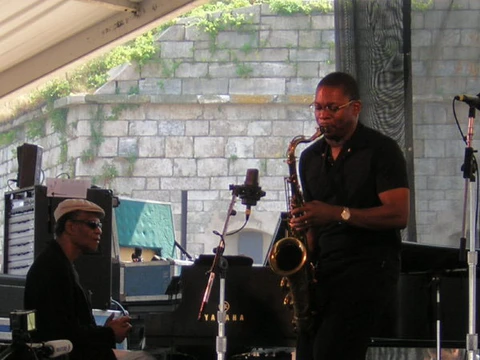
Buddy Rich
American jazz drummer and bandleader, influential for virtuoso technique.

He is considered one of the most influential drummers of all time, known for his virtuoso technique, power, and speed.
- field
- Jazz drummer, songwriter, conductor, bandleader
- nationality
- American
- known_for
- Virtuoso drumming, traditional grip, leading big bands
Verified Timeline
Lore & Background
At 18 months old, he joined his parents' act, drumming and tap-dancing. and Australia, becoming the second-highest-paid child entertainer in the 1930s. Marines as a Judo instructor. After the war, he formed his own big band with financial support from Frank Sinatra.
Reader's Guide
Buddy Rich's significance lies in his extraordinary drumming technique and his leadership of big bands during an era when their popularity waned. He never learned to read sheet music, relying instead on memory and rehearsal. His television appearances, including a drum battle with Muppet character Animal, reached wide audiences. His influence on drummers is profound, with many citing his 1973 PBS concert as a prime influence. Despite his commercial success, he remained known for his powerful, fast playing and use of both traditional and matched grips.
Did You Know?
- Rich began drumming at age two and by four was headlining Broadway as 'Baby Traps the Drum Wonder.'
- He never learned to read sheet music, preferring to listen to drum parts played by his roadie and rely on memory.
- Rich engaged Muppet drummer Animal in a drum battle on a 1981 episode of The Muppet Show.
The Clarinet's Reluctant Survival
DeFranco's story is inseparable from the instrument he chose to champion. Growing up in South Philadelphia after being born in Camden, New Jersey, he was already handling a clarinet at age nine, and within five years he had captured a national Tommy Dorsey swing contest. His professional entry into the music world came at a particularly awkward moment: the big-band era was collapsing, and the clarinetists who had defined it—Artie Shaw, Benny Goodman—were losing their audiences. Where the majority of jazz clarinetists quietly abandoned the instrument or pivoted to other roles, DeFranco refused to follow that path. He committed himself to the clarinet as his sole voice and became one of the very few players to carry it into the bebop era. In 1950 he spent a year in Count Basie's septet, and in the early 1950s he led a small group featuring pianist Sonny Clark and guitarist Tal Farlow, recording for MGM, Norgran, and Norman Granz's Verve label. That stubborn, singular devotion to one reed instrument set the tone for everything that followed.
Steering the Glenn Miller Ship
Under the banner 'The World Famous Glenn Miller Orchestra, Directed By Buddy DeFranco,' he guided the ensemble through a full decade of recordings and performances that kept Miller's legacy alive for new generations. The range of the catalog—covering Tijuana Brass arrangements, live casino dates, and stereo reissues—shows a bandleader who treated the Miller name not as a museum piece but as a living, adaptable sound. For nearly ten years, DeFranco's clarinet and musical judgment were the defining force behind one of jazz's most recognizable orchestral brands.
A Web of Collaboration
DeFranco's career was built as much on partnership as on solo leadership. His most sustained creative alliance was with accordionist Tommy Gumina, for whom he co-led four quartet albums between 1960 and 1964 on Decca and Mercury. The breadth of his sideman and guest credits is staggering: he sat in with Count Basie, Charlie Parker, Dizzy Gillespie, Miles Davis, Art Tatum, Oscar Peterson, Billie Holiday, Gene Krupa, Art Blakey, Terry Gibbs, and many others. On the recording side, his name appears on sessions with Tommy Dorsey, Lionel Hampton, Ella Fitzgerald, Stan Getz, Gerry Mulligan and Chet Baker, and even Buddy Rich. In his later decades, a long-running friendship with saxophonist Terry Gibbs produced a string of albums from 1981 through 1999, including tributes to Benny Goodman and Steve Allen. Dozens of leader credits and an equally vast sideman catalog make him one of jazz's most connected musical figures.
Recognition and a Long Arc
DeFranco's contributions were acknowledged repeatedly by the jazz press and public. Over his career he collected twenty awards from DownBeat magazine, nine from Metronome, and sixteen Playboy All-Stars honors—testament to a musician who remained relevant across multiple decades and stylistic shifts. He worked with pianists as varied as Oscar Peterson, Dave McKenna, and Jim Gillis; with guitarist Martin Taylor; and with Putte Wickman. A career that began with a child winning a swing contest in South Philadelphia and ended with a man in his late eighties still cutting records represents one of the most sustained and versatile journeys in American jazz history.
Frequently Asked Questions
What made Buddy Rich's drumming technique stand out?
Rich paired a traditional grip with extraordinary velocity and dynamic control, setting a technical benchmark that few drummers have since matched. His ability to sustain blistering tempos while keeping every stroke crisp and articulate became the signature of his style.
What role did Buddy Rich play in big band jazz?
Beyond the drum kit, Rich served as a conductor and bandleader, fronting his own ensembles for decades and shaping the sound of mid-century swing and bebop. He also composed and arranged material, extending his creative reach well past rhythm section duties.
Why is Buddy Rich considered so important to jazz history?
His drumming proved the instrument could function as a lead voice rather than mere timekeeping, raising the technical ceiling for everyone who followed. Countless jazz, rock, and fusion drummers still point to his recordings as a foundational influence on their own playing.
More in Jazz Innovators 1-19
Related in Jazz Innovators
Links follow this subject's own source article.
Spotted an error? Know more?
This is a living reference — every entry is fact-audited, and reader corrections feed straight into our audit queue. Suggest an edit · See this site's audit record