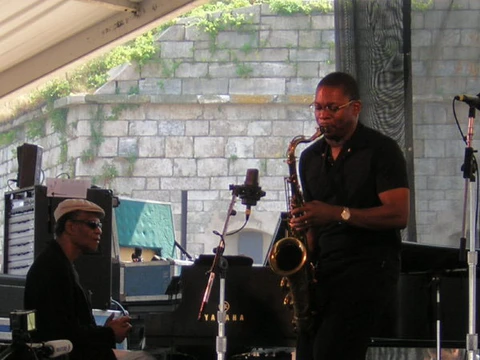
Coleman Hawkins
Jazz tenor saxophonist featured in the Ken Burns Jazz companion album series.

Coleman Hawkins was a jazz tenor saxophonist whose recordings were included in the companion album releases for the 2001 Ken Burns documentary series *Jazz*. His work was grouped alongside other major figures such as Count Basie, Art Blakey, John Coltrane, Ella Fitzgerald, Dizzy Gillespie, Billie Holiday, Charlie Parker, Sonny Rollins, Sarah Vaughan, and Lester Young on the Verve label. This placement within the series' curated discography acknowledged his role in the jazz narrative that the documentary traced from 1917 through 2001, though he was not one of the two central figures—Louis Armstrong and Duke Ellington—around whom the ten-episode story was structured.
- field
- Jazz tenor saxophonist
Verified Timeline
Lore & Background
The 2001 Ken Burns documentary *Jazz* treated Louis Armstrong and Duke Ellington as its central figures, providing the narrative thread around which the stories of other major figures turned. Coleman Hawkins was among those other major figures, alongside Sidney Bechet, Count Basie, Benny Goodman, Billie Holiday, Charlie Parker, Miles Davis, and John Coltrane. On November 7, 2000, Verve released a single-artist compilation album dedicated to Hawkins as part of a coordinated set of twenty-two such releases, all titled *Ken Burns Jazz*. These albums were designed to accompany the ten-episode PBS documentary. The project also included a five-CD box set called *Ken Burns Jazz: The Story of America's Music* and a sampler disc titled *The Best of Ken Burns Jazz*. In 2002, Columbia released two low-priced box sets, each containing three of the previously released single-artist collections.
Reader's Guide
Coleman Hawkins's significance in the Ken Burns *Jazz* series is established through his inclusion in the companion album releases. His Verve compilation was part of a coordinated set of twenty-two single-artist albums released on November 7, 2000, all bearing the title *Ken Burns Jazz*. These albums were distributed simultaneously across both the Verve and Columbia/Legacy labels. The Verve label released compilations for Hawkins alongside Count Basie, Art Blakey, John Coltrane, Ella Fitzgerald, Dizzy Gillespie, Billie Holiday, Charlie Parker, Sonny Rollins, Sarah Vaughan, and Lester Young. The Columbia/Legacy label released compilations for Louis Armstrong, Sidney Bechet, Dave Brubeck, Ornette Coleman, Miles Davis, Duke Ellington, Benny Goodman, Herbie Hancock, Fletcher Henderson, Charles Mingus, and Thelonious Monk. The documentary itself, a ten-part miniseries broadcast on PBS in 2001, was narrated by Keith David and featured interviews with musicians and critics including Wynton Marsalis, who served as artistic director and co-producer. The series was nominated for an Emmy Award for Outstanding Documentary or Nonfiction Series.
Did You Know?
- Coleman Hawkins was one of the major figures featured in the Ken Burns documentary *Jazz*, alongside Sidney Bechet, Count Basie, Benny Goodman, Billie Holiday, Charlie Parker, Miles Davis, and John Coltrane.
- A single-artist compilation album dedicated to Coleman Hawkins was released by Verve on November 7, 2000, as part of the *Ken Burns Jazz* companion series.
- The *Ken Burns Jazz* companion album project included 22 single-artist compilations, a five-CD box set, and a sampler disc.
- The documentary *Jazz* was a ten-part miniseries broadcast on PBS in 2001, with episodes running 87 to 123 minutes each.
- The series was nominated for an Emmy Award for Outstanding Documentary or Nonfiction Series.
Position Among Jazz's Greats
The 2001 Ken Burns documentary on jazz history treated Louis Armstrong and Duke Ellington as its narrative spine, with the stories of other pivotal musicians woven around them. Coleman Hawkins found his place in this grand chronicle through the series' companion music releases, where his recordings were grouped alongside those of Count Basie, Art Blakey, John Coltrane, Ella Fitzgerald, Dizzy Gillespie, Billie Holiday, Charlie Parker, Sonny Rollins, Sarah Vaughan, and Lester Young on the Verve label. This particular roster spans the swing era's big-band leaders into the bebop revolution and beyond, situating Hawkins within a continuum of American musical innovation that the documentary traced from 1917 through 2001. By placing his work in this constellation of artists, the project acknowledged his significance within the broader jazz narrative without making him one of the two central figures around whom the entire ten-episode story was structured.
The Companion Album Release
On November 7, 2000, Verve issued a single-artist compilation album dedicated to Coleman Hawkins as part of a coordinated set of twenty-two such releases, each bearing the title Ken Burns Jazz. These albums were designed to accompany the ten-episode PBS documentary of the same name and were distributed simultaneously across both the Verve and Columbia/Legacy labels. Beyond the individual artist discs, the project included a five-CD box set called Ken Burns Jazz: The Story of America's Music, along with a sampler disc titled The Best of Ken Burns Jazz that offered a cross-section of the entire collection. Two years later, in 2002, Columbia followed up with two budget-priced box sets, each bundling three of the previously released single-artist compilations for a more accessible price point. Hawkins' Verve disc thus entered a carefully curated ecosystem of jazz recordings intended to give listeners a comprehensive aural companion to the visual history on screen.
The Documentary Context
The Ken Burns Jazz series that gave Hawkins' compilation its broader context was a ten-part documentary miniseries broadcast on PBS in 2001, with each episode running between 87 and 123 minutes. Produced by Florentine Films in cooperation with the BBC and in association with WETA-TV in Washington, the project earned an Emmy nomination for Outstanding Documentary or Nonfiction Series. Keith David provided the narration, while trumpeter Wynton Marsalis served as both artistic director and co-producer, guiding the series' interpretive framework. The visual language followed Burns' signature approach: slow pans and zooms across archival photographs intercut with period film footage, all underscored by the music of the era being examined. Duke Ellington's 1938 recording of "I Let a Song Go Out of My Heart" served as a recurring musical motif bookending each individual episode, tying the sprawling narrative together with a single, elegantly chosen phrase.
Critical Perspectives on the Series
Reception of the series that included Hawkins' music was notably mixed. Reason magazine acknowledged Burns' skill as a biographer while questioning whether his approach was truly analytical or properly historical. Jason Van Bergen likened the nearly nineteen hours of footage to a fine wine and suggested that a full discussion of every episode would require a master's thesis. In The New York Times, Ben Ratliff praised the program's thematic focus on personal encounters between American whites and blacks. Deroy Murdock in National Review compared the viewing experience to a Thanksgiving dinner—rich, satisfying, and at times mesmerizing. However, William Berlind in The Observer argued that Marsalis's guidance rendered a living, evolving art form as though frozen in time. The Guardian raised concerns about the series' Afrocentric emphasis, while Professor Frank Tirro criticized specific historical claims as unsupported speculation rather than rigorous scholarship.
Frequently Asked Questions
Who is Coleman Hawkins?
Coleman Hawkins (1904–1969) was an American jazz tenor saxophonist, widely regarded as the first major solo voice on that instrument. Nicknamed "Hawk" or "Bean," he transformed the tenor sax from a background band part into a lead voice with its own expressive identity.
What made Coleman Hawkins's improvisational style distinctive?
His playing leaned on arpeggiated runs and a deeply vibrato-rich, emotionally charged tone that set him apart from the more restrained clarinet-influenced players of his era. That bold, virtuosic approach became the template a whole generation of tenor saxophonists studied and emulated.
What is Coleman Hawkins's most iconic recording?
His 1939 rendition of "Body and Soul" is generally considered his signature track and a landmark in jazz history. The performance showcased his rich tonal palette and daring harmonic choices, cementing the tenor sax as a vehicle for deep solo expression.
How did Coleman Hawkins connect the swing era to bebop?
Although he is most associated with big-band swing, his adventurous improvisations in the late 1930s and early 1940s directly inspired the younger musicians who went on to create bebop. His willingness to push harmonic boundaries and prioritize the solo voice over ensemble arrangement made him a bridge between those two eras.
Why is Coleman Hawkins considered so important in jazz history?
He essentially defined what the tenor saxophone could do in a jazz context, moving it from a supporting role to the center of the musical conversation. Without his pioneering work, the path for later giants like Charlie Parker, Sonny Rollins, and John Coltrane would have looked very different.
More in Jazz Innovators 1-19
Related in Jazz Innovators
Links follow this subject's own source article.
Spotted an error? Know more?
This is a living reference — every entry is fact-audited, and reader corrections feed straight into our audit queue. Suggest an edit · See this site's audit record