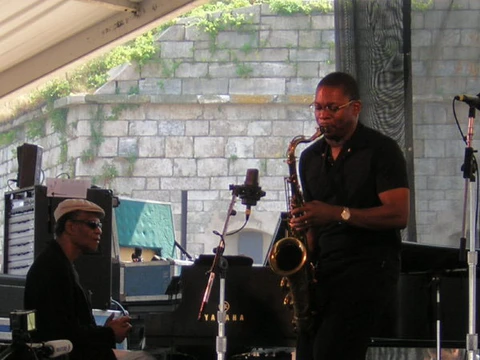
Bud Powell
American jazz pianist and bebop pioneer.

A pioneer in the development of bebop, Powell is listed among the most influential bebop artists, who were typically composer-performers.
- field
- Jazz pianist and composer
- nationality
- American
- known_for
- Pioneer of bebop; right-handed attacking piano style; compositions including 'Un
Lore & Background
He is recognized as one of the most influential bebop artists, a group of composer-performers that included alto sax players Charlie Parker and Sonny Stitt; tenor sax players Dexter Gordon, Sonny Rollins, and James Moody; clarinet player Buddy DeFranco; trumpeters Fats Navarro, Miles Davis, and Dizzy Gillespie; pianists Barry Harris and Thelonious Monk; trombonist J.J. Johnson; electric guitarist Charlie Christian; and drummers Kenny Clarke, Max Roach, and Art Blakey. Powell's significance lies in his role as a pioneer of bebop and his transformation of jazz piano technique. His recordings and live performances with Charlie Parker, Sonny Stitt, and Max Roach during the late 1940s and early 1950s were important in the development of modern jazz piano technique. Despite struggles with police brutality, institutionalization, electroconvulsive therapy, and alcohol addiction, his musical legacy endures.
Reader's Guide
Bud Powell's significance lies in his role as a pioneer of bebop and his transformation of jazz piano technique. His recordings and live performances with Charlie Parker, Sonny Stitt, and Max Roach during the late 1940s and early 1950s were important in the development of modern jazz piano technique. Despite struggles with police brutality, institutionalization, electroconvulsive therapy, and alcohol addiction, his musical legacy endures.
Did You Know?
- Bud Powell is listed among the most influential bebop artists, alongside Charlie Parker, Dizzy Gillespie, Thelonious Monk, and Max Roach.
- The classic bebop combo that Powell played in consisted of saxophone, trumpet, double bass, drums and piano.
- Bebop developed in the early to mid-1940s in the United States as a 'musician's music' not intended for dancing.
- The term 'bebop' is derived from nonsense syllables used in scat singing, first appearing in a 1928 recording by McKinney's Cotton Pickers.
- Thelonious Monk claimed his composition originally titled 'Bip Bop' gave the style its name 'bebop'.
Pianist in the Bebop Vanguard
Bud Powell stands among the most influential figures in the bebop movement, recognized specifically as a pianist and composer-performer alongside peers like Barry Harris and Thelonious Monk. In the classic bebop ensemble, the piano occupied a foundational position within the small combo format—typically saxophone, trumpet, piano, guitar, double bass, and drums. Unlike the large, orchestrated big bands of the swing era that featured sixteen to eighteen musicians playing in unison, the bebop group relied on a leaner configuration where the ensemble served a supportive role for individual soloists. As a pianist in this context, Powell would have been central to the harmonic engine of the group, anchoring the rhythm section while also stepping forward as a soloist. The bebop format called for the piano to navigate complex chord progressions, rapid key changes, and substitute chords, all while providing the tonal framework against which other musicians improvised. His inclusion in the pantheon of bebop's defining artists underscores the centrality of the piano to the style's harmonic and melodic language.
The Musical Revolution He Helped Forge
Bebop emerged in the early to mid-1940s as a younger generation of jazz musicians pushed the creative boundaries of the genre well beyond the dance-oriented swing style that had dominated the previous decade. Rather than serving as background for dancers, this new "musician's music" demanded close, attentive listening from its audience. By shedding the obligation to be danceable, bebop performers freed themselves to play at dramatically faster tempos and explore more adventurous harmonic territory. The shift in ensemble size was equally significant: where swing had relied on large, tightly arranged big bands, bebop favored the intimate small combo, with each player given space to improvise. The typical structure involved presenting a melody—the "head"—with the rhythm section, followed by extended solo passages from each performer, then a return to the head. Powell, as a composer-performer within this movement, contributed to a musical culture that prioritized individual expression and spontaneous creation over pre-arranged orchestration, fundamentally reshaping what jazz could be.
Harmonic Architecture and Improvisation
The bebop language that Powell helped define was built on a sophisticated harmonic vocabulary. Compositions frequently drew chord progressions directly from popular swing-era standards, then layered entirely new, more complex melodies over them—a practice known as contrafact that had roots in earlier jazz but became central to bebop. Common progressions included the blues, infused with II-V motion, and the "rhythm changes" pattern derived from the 1930s standard "I Got Rhythm." Bebop chord voicings often discarded the root and fifth tones, instead building on the leading intervals that defined each chord's tonality, opening up new creative possibilities for harmonic movement. Improvisation in this style was virtuosic, drawing on harmonic structure, scales, and occasional melodic references to the original tune or other well-known lines. Sometimes solos were entirely spontaneous, original melodies from beginning to end. The rhythm section's role expanded beyond mere timekeeping, and the overall effect was one of intricate, asymmetrical phrasing and angular melodic lines that challenged listeners accustomed to the bouncy, organized compositions of the Goodman and Miller era.
A Music That Demanded Listening
To the general public of the 1940s, bebop sounded jarringly different from the familiar, bouncy compositions of Benny Goodman and Glenn Miller. Where swing had been organized, danceable, and broadly accessible, bebop appeared racing, nervous, erratic, and often fragmented to ears unaccustomed to its demands. The music was not intended for dancing, and this very constraint became its liberation—freeing performers from the need to maintain a steady, predictable groove and instead allowing them to push tempos higher and harmonies further. The name "bebop" itself carried the spirit of this irreverence, likely derived from nonsense syllables in scat singing, with the first known example appearing in a 1928 recording by McKinney's Cotton Pickers. Thelonious Monk claimed his composition originally titled "Bip Bop" gave the style its name, while Dizzy Gillespie suggested audiences coined the term after hearing him scat unnamed compositions to his players. By the 1950s, the bebop musician had become a stock character in popular jokes, overlapping with the beatnik figure—a testament to how deeply this challenging, listening-oriented music had penetrated the broader cultural imagination.
Frequently Asked Questions
Who is Bud Powell?
Bud Powell (1924–1966) was an American jazz pianist and composer born in Harlem, New York. He is widely recognized as one of the foundational architects of bebop, shaping how the piano could express that fast, complex harmonic language.
What made Bud Powell's piano style unique?
Powell favored a right-handed, aggressively attacking approach to the keys, weaving intricate bebop lines and rapid runs through his left-hand comping. This phrasing style set a new template for how jazz pianists could voice improvisation on the instrument.
What songs did Bud Powell compose?
Among his best-known written works are "Bouncing with Bud," "Un Poco Loco," and "Parisian Thoroughfare." These pieces remain staples of the bebop piano repertoire and are frequently recorded by other players.
Which pianists were influenced by Bud Powell?
Later jazz pianists such as Walter Davis Jr., Toshiko Akiyoshi, and Barry Harris all credited Powell's phrasing and harmonic approach as a major influence on their own playing. His impact on bebop piano technique extended well beyond his own recording career.
When and where did Bud Powell die?
Powell passed away on July 31, 1966, at the age of 41. His relatively short life left a lasting mark on jazz, with his innovations in bebop piano continuing to shape the instrument's role in modern jazz.
More in Jazz Innovators 1-19
Related in Jazz Innovators
Links follow this subject's own source article.
Spotted an error? Know more?
This is a living reference — every entry is fact-audited, and reader corrections feed straight into our audit queue. Suggest an edit · See this site's audit record