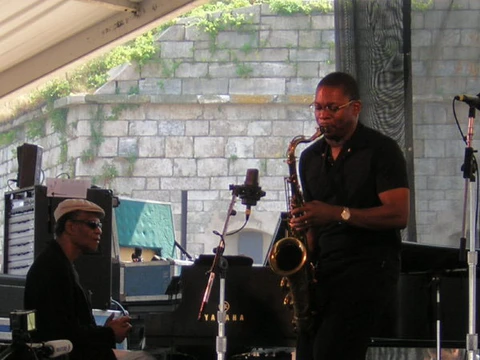
Elvin Jones
American jazz drummer of the post-bop era, influential with Coltrane.

His brothers, Hank and Thad, were also celebrated jazz musicians.
- died
- May 18, 2004, Englewood, New Jersey
- field
- Jazz drummer
- nationality
- American
- known_for
- Member of John Coltrane's quartet; leader of the Elvin Jones Jazz Machine
Lore & Background
By age two, drums held a special fascination for him; he would watch circus parades and was excited by marching band drummers. He joined his high school's black marching band, developing his foundation in rudiments. Jones said of that period, 'Every night when we hit the bandstand... the weariness just dropped from us.
Reader's Guide
Elvin Jones's significance lies in his transformative role as a drummer in post-bop jazz, particularly during his tenure with John Coltrane's quartet, where his polyrhythmic style and legato phrasing helped redefine the rhythmic feel of jazz, often compared to the innovations of Louis Armstrong and Charlie Parker. After leaving Coltrane, Jones led his own groups, notably the Elvin Jones Jazz Machine, which continued to explore modal jazz and featured both established and emerging musicians. He also contributed to albums of the modal jazz era, such as The Real McCoy with McCoy Tyner and Speak No Evil with Wayne Shorter. Jones's influence persists through his recordings and the many drummers who cite him as a principal inspiration.
Did You Know?
- He appeared as the villain Job Cain in the 1971 musical Western film Zachariah, performing a drum solo after winning a saloon gunfight.
- Jones played drums on beat poet Allen Ginsberg's 1970 LP Songs of Innocence and Experience, a musical adaptation of William Blake's poetry.
- In 1990 and 1992, the Elvin Jones Jazz Machine partnered with Wynton Marsalis, performing at The Bottom Line in New York.
Frequently Asked Questions
What is Elvin Jones most famous for?
Jones is widely celebrated for his driving, polyrhythmic drumming in John Coltrane's quartet, appearing on landmark recordings such as My Favorite Things, A Love Supreme, and Ascension between 1960 and 1965. His powerful four-on-the-floor pulse and independent cymbal work gave soloists a rock-solid foundation while propelling the music forward.
Why is Elvin Jones important to jazz history?
His rhythmic approach became a foundational model for post-bop and free-jazz drummers, demonstrating how a timekeeper could simultaneously drive momentum and create complex counter-rhythms. He was inducted into the Modern Drummer Hall of Fame in 1995 and ranked 23rd on Rolling Stone's list of the greatest drummers.
Did Elvin Jones have any notable family connections in jazz?
Yes — his brothers Hank Jones and Thad Jones were both highly respected jazz pianists and arrangers in their own right. The three brothers together represent a remarkable cluster of musical talent in the history of American jazz.
More in Jazz Innovators 1-19
Spotted an error? Know more?
This is a living reference — every entry is fact-audited, and reader corrections feed straight into our audit queue. Suggest an edit · See this site's audit record