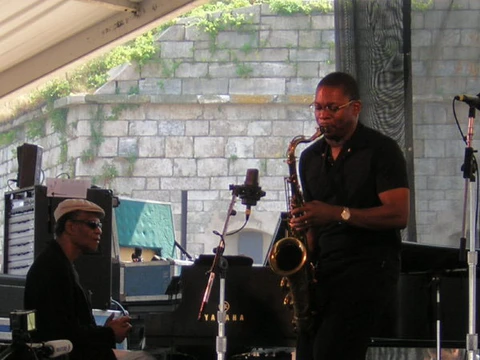
Thelonious Monk
American jazz pianist and composer with a unique improvisational style.

Thelonious Sphere Monk (October 10, 1917 – February 17, 1982) was an American jazz pianist and composer. He had a unique improvisational style and made numerous contributions to the standard jazz repertoire, including "'Round Midnight", "Blue Monk", "Straight, No Chaser", "Ruby, My Dear", "In Walked Bud", and "Well, You Needn't". As of 2009, Monk was the second-most-recorded jazz composer in history, after Duke Ellington.
- born
- October 10, 1917, Rocky Mount, North Carolina
- died
- February 17, 1982
- field
- Jazz pianist and composer
- nationality
- American
- known_for
- Unique improvisational style; compositions including 'Round Midnight; second-mos
Verified Timeline
Lore & Background
Thelonious Monk was born on October 10, 1917, in Rocky Mount, North Carolina, the son of Thelonious (or Thelious) and Barbara Monk. His family moved to Manhattan in 1922. He briefly studied trumpet before switching to piano at age nine, learning stride style from a neighbor, Alberta Simmons, and classical piano from Simon Wolf, an Austrian-born pianist and violinist. He attended Stuyvesant High School but did not graduate. Monk put his first band together at 16 and by the early 1940s was house pianist at Minton's Playhouse in Harlem, where his work was crucial in the formulation of bebop. In 1944, he made his first commercial recordings with the Coleman Hawkins Quartet. Monk married Nellie Smith in 1947; they had a son, T. S. Monk (called Toot), on December 27, 1949, and a daughter, Barbara (Boo-Boo), on September 5, 1953. In August 1951, police found narcotics in a car occupied by Monk and his friend Bud Powell; Monk refused to testify, and the police confiscated his New York City Cabaret Card, restricting his ability to perform in venues serving liquor for several years. A coterie of musicians led by Randy Weston introduced Monk to Black-owned bars and clubs in Brooklyn that flouted the law, enabling him to play one-night engagements.
Reader's Guide
Monk's compositions and improvisations feature dissonances and angular melodies, often using flat ninths, flat fifths, unexpected chromatic notes, low bass notes and stride, and fast whole tone runs. His playing style combined a highly percussive attack with abrupt, dramatic use of switched key releases, silences, and hesitations. He is one of five jazz musicians to have been featured on the cover of Time magazine. His composition "'Round Midnight" is widely recognized as the most recorded jazz standard composed by a single artist. Monk's distinctive look included suits, hats, and sunglasses, and he had an idiosyncratic habit during performances of stopping, standing up, and dancing for a few moments before returning to the piano. Despite early commercial indifference—his first Village Vanguard gig in September 1948 drew not a single person—Monk's work was championed by figures such as Lorraine Gordon, who wrote to the editor of PM describing Monk as "a genius living here in the heart of New York, whom nobody knows," and Baroness Pannonica de Koenigswarter, who "paid Monk's bills, dragged him to an endless array of doctors, put him and his family up in her own home and, when necessary, helped Nellie institutionalize him." His recordings for Blue Note and Prestige, including collaborations with Sonny Rollins, Art Blakey, and Max Roach, are now regarded as significant contributions to jazz.
Did You Know?
- Monk's birth certificate spelled his first name as 'Thelious' and did not list his middle name, taken from his maternal grandfather, Sphere Batts.
- In March 1943, Monk was labeled by an Army psychiatrist as a 'psychiatric reject' and did not serve.
- Monk's first Village Vanguard gig in September 1948 drew not a single person.
- In 1954, Riverside Records bought out Monk's previous Prestige contract for a mere $108.24.
- Monk's composition "'Round Midnight" is widely recognized as the most recorded jazz standard composed by a single artist.
Frequently Asked Questions
Who is Thelonious Monk?
Thelonious Sphere Monk (1917–1982) was an American jazz pianist and composer born in Rocky Mount, North Carolina. He is celebrated as one of the most original and forward-thinking figures in the entire jazz canon.
What are Thelonious Monk's most famous compositions?
His signature tunes include "Round Midnight," "Blue Monk," "Straight, No Chaser," "Ruby, My Dear," "In Walked Bud," and "Well, You Needn't." By 2009 he had become the second-most-recorded jazz composer in history, trailing only Duke Ellington.
What made Thelonious Monk's piano style so distinctive?
Monk built his improvisations around angular, dissonant melodic lines, deliberate rhythmic silences, and a percussive touch that rejected the smooth legato of his peers. The result was a piano voice that sounded almost no one else's, making his phrasing instantly recognizable.
How did Thelonious Monk's life end?
Monk died on February 17, 1982, in New York City. In his final years he had largely stepped away from public performance and was dealing with serious health problems, including a stroke.
Why is Thelonious Monk considered so important to jazz?
He expanded the harmonic and rhythmic vocabulary of the piano, proving that a jazz composition could be built on dissonance and space rather than conventional chord progressions. His influence radiates through virtually every subsequent generation of jazz pianists and composers.
More in Jazz Innovators 1-19
Related in Jazz Innovators
Links follow this subject's own source article.
Spotted an error? Know more?
This is a living reference — every entry is fact-audited, and reader corrections feed straight into our audit queue. Suggest an edit · See this site's audit record