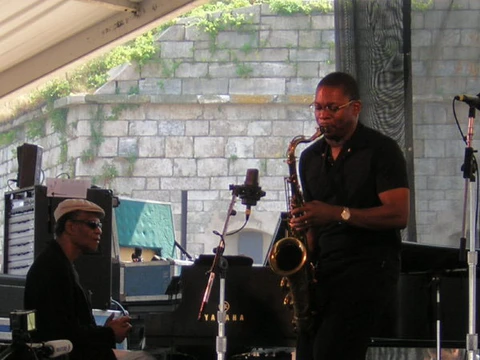
Dave Brubeck
American jazz pianist and composer of cool jazz.

Dave Brubeck was a jazz pianist and composer who hired alto saxophonist Paul Desmond, forming a quartet. Brubeck's quartet recorded *Time Out* in 1959, which reached No. 2 on the Billboard "Pop Albums" chart. His work is associated with cool jazz, a style characterized by relaxed tempos and a lighter tone. Brubeck's approach ran counter to bebop, as Desmond did not employ a sound or style heavily indebted to Charlie Parker. The quartet's music helped define the cool aesthetic, blending formal arrangements with a subdued, reflective attitude.
- field
- Jazz pianist and composer
- known_for
- Cool jazz, album 'Time Out'
Verified Timeline
Lore & Background
Dave Brubeck formed a quartet with alto saxophonist Paul Desmond. Desmond used an approach that ran counter to bebop, in the sense that he did not employ a sound or style heavily indebted to Charlie Parker. In a 2013 interview, Konitz noted that "the blues never connected with me," and further explained "I knew and loved Charlie Parker and copied his bebop solos like everyone else. But I didn't want to sound like him. So I used almost no vibrato and played mostly in the higher register. That's the heart of my sound." While this quote is from Konitz, it illustrates the same cool aesthetic that Desmond and Brubeck pursued. Brubeck's quartet recorded *Time Out* in 1959, which reached No. 2 on the Billboard "Pop Albums" chart. The cool influence stretches into such later developments as bossa nova, modal jazz, and even free jazz.
Reader's Guide
Dave Brubeck's significance lies in his quartet's 1959 album *Time Out*, which reached No. 2 on the Billboard "Pop Albums" chart. The album exemplifies cool jazz, a style that emerged as a reaction to bop, characterized by more moderate tempos and "a more reflective attitude." Brubeck's quartet featured Paul Desmond, whose alto saxophone work avoided the blues-heavy approach of Charlie Parker, instead using almost no vibrato and playing mostly in the higher register. The cool influence of Brubeck's work stretches into later developments such as bossa nova, modal jazz (especially in the form of Davis's *Kind of Blue* (1959)), and even free jazz (in the form of Jimmy Giuffre's 1961–1962 trio).
Did You Know?
- Dave Brubeck's quartet recorded *Time Out* in 1959, which reached No. 2 on the Billboard 'Pop Albums' chart.
- Brubeck hired alto saxophonist Paul Desmond, who used an approach that ran counter to bebop and did not employ a sound heavily indebted to Charlie Parker.
- The cool influence of Brubeck's work stretches into later developments such as bossa nova, modal jazz, and even free jazz.
- Brubeck's quartet was part of the cool jazz movement, which emerged as a reaction to bop with more moderate tempos and a reflective attitude.
Frequently Asked Questions
Who is Dave Brubeck?
Dave Brubeck (1920–2012) was an American jazz pianist and composer widely regarded as a leading figure in the cool jazz movement. He is best remembered for pushing rhythmic and harmonic boundaries in popular music.
What made Dave Brubeck's music distinctive?
His compositions were defined by unusual time signatures and the layering of contrasting rhythms, meters, and tonalities within a single piece. He wove together classical, jazz, and blues influences into a cohesive personal style that set him apart from his peers.
What is the album Time Out?
Time Out is a 1959 studio album that became the first jazz record to sell more than one million copies. It showcased Brubeck's signature approach to unconventional meter structures and remains a cornerstone of the cool jazz canon.
What is Take Five and why is it famous?
Take Five is a composition from the Time Out album that holds the record as the highest-selling jazz single ever released. Its memorable five-beat rhythm made it a radio staple and a widely covered standard across genres.
Why is Dave Brubeck considered important in jazz history?
He proved that mainstream audiences would embrace complex, non-standard rhythmic structures in popular music. By fusing classical composition with jazz improvisation and blues phrasing, he opened new creative pathways for subsequent generations of jazz artists.
More in Jazz Innovators 1-19
Related in Jazz Innovators
Links follow this subject's own source article.
Spotted an error? Know more?
This is a living reference — every entry is fact-audited, and reader corrections feed straight into our audit queue. Suggest an edit · See this site's audit record